
• Skip to content
  • Skip to primary sidebar

Header Right

  • Home
  • About
  • Contact

How Small Businesses Can Use Artificial Intelligence

July 18, 2022 by admin

Medical technology concept. Remote medicine. Electronic medical record.Science fiction movies and books may portray artificial intelligence as a human-like giant brain with thousands of wires coming from it that control whole cities and their populations. The reality today is that artificial intelligence is unobtrusive, everywhere, and we are interacting with it multiple times daily without always recognizing that we are.

Artificial intelligence is being used by large corporations in a range of areas, including sales, marketing, customer service, employee training/coaching, and logistics. Small businesses can also employ artificial intelligence to improve customer service, reduce costs, and help drive revenues.

What It Is

Artificial intelligence (AI) is a branch of computer science that focuses on building smart machines capable of performing tasks that typically require human intelligence. Essentially, it endeavors to simulate human intelligence in machines. Examples of AI applications many people are familiar with include smart assistants (such as Siri and Alexa) and virtual agents that interact with customers and guide them to possible solutions. Looking ahead, self-driving trucks and cars are in various stages of development, and some vehicles already have self-driving features.

Customer Service

AI can be deployed through the use of chatbots to handle a variety of tasks, such as directing callers to the function they want (e.g., automatic payments). On a more complex level, AI can be used online to help customers with product search and discovery and respond to requests with relevant recommendations. Businesses can use data gathered from AI chatbot customer interactions to identify where in the process problems may arise and what these problems are so that they can be eliminated in the future.

Logistics

Moving goods from one point to another requires up-to-the-minute data so that what is being shipped is shipped in the most efficient and cost-effective way possible. Certain AI programs can predict points where congestion may happen and help redirect trucks and vans so that they avoid bottlenecks and slowdowns. AI essentially streamlines the supply chain. It can do something similar when it comes to warehouse management — identifying choke points that slow the movement of goods from point A to point B.

Marketing

AI marketing sets out to leverage customer data and machine learning to anticipate a customer’s next move and to nudge that customer toward either buying something or increasing his or her average order value. Businesses are using AI to attract, nurture, and convert prospects.

By tracking a customer’s online searches, AI programs can identify what products an individual might be interested in and may be considering buying. AI can target that individual with ads highlighting products or services previously identified as being of interest to the customer. This approach essentially uses machine learning to offer personalized product recommendations.

Sales Training

AI can be used to coach salespeople to improve their sales skills and help them increase their percentage of successful sales calls. AI programs exist that can analyze a number of variables that are used by the most successful salespeople and use that data to identify strategies that can be replicated and utilized by other salespeople within the organization.

As with any technology, there are costs involved in incorporating AI into a company’s operations. A financial professional can assist you in analyzing the costs and potential financial benefits of any new technological enhancements your small business may be considering.

Filed Under: Best Business Practices

How QuickBooks Online Helps You Track Mileage

June 22, 2022 by admin

qb-track-mileageWith gas prices so high, you need to track your travel costs as closely as possible. Consider getting a tax deduction for your business mileage.

If you drive even a little for business, it’s easy to let mileage costs slide. After all, it’s a pain to keep track of your tax-deductible mileage in a little notebook and do all the calculations required. If you do rack up a lot of business miles, you probably forget to track some trips and end up losing money.

QuickBooks Online offers a much better way. Its Mileage tools include simple fill-in-the-blank records that allow you to document individual trips. You can either enter the starting point and destination and let the site calculate your mileage and deduction or enter the number of miles yourself.

If you use QuickBooks Online’s mobile app, it can track your miles automatically as you drive (as long as you have the correct settings turned on). Here’s a look at how all of this works.

Setting Up

To get started, click the Mileage link in QuickBooks Online’s toolbar. The screen that opens will eventually display a table that contains information about your trips, but you need to do a little setup first. Click the down arrow next to Add Trip in the upper right corner and select Manage vehicles. A panel will slide out from the right. Click Add vehicle.

quickbooks online tips

You’ll need to supply information about your vehicles before you can start entering trips.

You’ll need to supply the vehicle’s year, make, and model. Do you own or lease it, and on what date was the vehicle purchased or leased and put into service? Do you want to have your annual mileage calculated by entering odometer readings or have QuickBooks Online track your business miles driven automatically? When you’re done making your selections and entering data, click Save.

Entering Trip Data

You can download trips as CSV files or import them from Mile IQ, but you’re probably more likely to enter them manually. Click Add Trip in the upper right corner. In the pane that opens, you’ll enter the date of the trip and either the total miles or start and end point. You’ll select the business purpose and vehicle and indicate whether it was a round trip. When you’re done, click Save. The trip will appear in the table on the opening screen, and your current possible total deduction will be in the upper left corner, along with your total business miles and total miles.

If you want to designate a trip as personal, click the box in front of the trip in that table. In the black horizontal box that appears, click the icon that looks like a little person, then click Apply. Now, the trip will appear in the Personal column and will not count toward your business tax-deductible mileage.

quickbooks online tips

When you select a trip in the Mileage table, you can mark it as personal so it’s not included in your business tax-deductible miles.

Personal Trips Can Count, Too

If you use your vehicle(s) for personal as well as business purposes, tracking some of those miles can also mean a tax deduction. For tax year 2022, you can deduct 18 cents per mile for your travel to and from medical appointments. Note: Medical mileage is only deductible if medical exceeds a certain percent of AGI. Be sure to check with the IRS yearly tax code, as they update the mileage amounts annually.

And if you do volunteer work for a qualified charitable organization, the miles you drive in service of it can be deducted at the rate of 14 cents per mile. You can also claim the cost of parking and tolls, as long as you weren’t reimbursed for any of these expenses. Obviously, the IRS wants you to keep careful records of your charitable mileage, and QuickBooks Online can provide them.

QuickBooks Online doesn’t track these deductions, but you’ll at least have a record of the miles driven.

Auto-Track Your Miles

The easiest way to track your mileage in QuickBooks Online is by using its mobile app. You can launch this and have it record your mileage automatically as you’re driving. Versions are available for both Android and iOS, and they’re different from each other. They also have more features than the browser-based version of QuickBooks Online, like maps, rules, and easier designation of trips as business or personal.

quickbooks online tips

The iOS version of Mileage in the QuickBooks Online app

In both versions, you’ll need to click the menu in the lower right corner after you’ve opened the QuickBooks Online app and select Mileage. Make sure Auto-Tracking is turned on. Your phone’s location services tool must be turned on, too. There are other settings that vary between the two operating systems. You can search the help system of either app to make sure you get your settings correct if the onscreen instructions aren’t clear enough.

Of course, you won’t see the fruits of your mileage deductions until you file your 2022 taxes. But you can factor these savings in as you’re doing your tax planning during the year. Please let us help if you’re having any trouble with QuickBooks Online’s Mileage tools, or if you have questions with other elements of the site.

Filed Under: QuickBooks

Can’t Pay Your Income Taxes? Some Solutions

May 23, 2022 by admin

Two Businesswomen Meeting In OfficeDid you skip filing or request an extension on your 2021 taxes because you couldn’t pay? You have several options.

It’s happened to many people at one time or another. You wait until the last minute to prepare and file your income taxes, only to receive a very unpleasant surprise: You owe money, and you don’t have it to give. Even if you file for an extension, the IRS still expects you to send in what you estimate you’ll owe. If that’s absolutely impossible, you should always try to send in what you can.

The first thing you should do, of course, is to review your 1040 again. Did you take all of the credits and deductions that you should have? Or make any calculation errors? Did you somehow overstate your income?

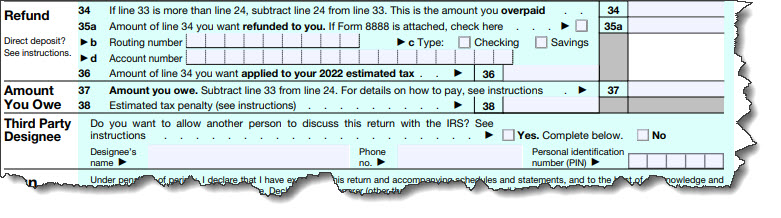
If after checking your return you still see that large number on line 37 (Amount you owe), try not to despair. And certainly, don’t neglect to file. Instead, take advantage of one of the many options you have.

tax tips

If you have to enter a big number on line 37 and you lack the funds to pay the IRS, there are several different steps you can take.

Try to Get a Loan

This is the best solution if it’s possible. Consider approaching family members who you know might have enough disposable income to help you out temporarily. If that’s not possible, check with your bank or credit union or online lenders. Paying interest may be more economical than dealing with IRS penalties and interest – and less harmful to your tax-paying history.

Set Up an Online Payment Plan

If you qualify (and most individual taxpayers do), you can set up an online payment plan through the IRS itself. You don’t have to contact the agency. It can all be done on the web. Once you’ve provided the required information, you’ll be notified immediately about your approval status. There are two types:

  • Short-term payment plan. This is designed for taxpayers who owe less than $100,000 and are going to repay it in 180 days or fewer. Keep in mind that the late-payment penalty and interest will continue to accrue, so those amounts have to be figured into your plan. There are no other fees for this.
  • Long-term payment plan. This is also known as an installment agreement, and it usually involves a setup fee, though low-income individuals might be able to have the fee waived or reimbursed. Your total debt to the IRS must be less than $50,000 (combined tax, interest, and penalties), and you’re required to make monthly payments. If you filed your return on time, your late-payment penalty will be reduced from up to 1 percent per month to 0.25 percent per month for as long as the installment agreement is in effect.

Offer in Compromise

It may be possible for you to settle your tax bill with the IRS and pay less than what you originally owed. There is a non-refundable fee of $200 that is generally waived for low-income taxpayers. You can see if you’re eligible by visiting this site and completing the multi-step questionnaire.

tax tips

You can use this IRS tool to see if you pre-qualify for an Offer in Compromise, which could reduce your tax bill

Delayed Collection

If you are absolutely unable to pay and the IRS can confirm this, the agency may delay collection until your finances improve. Call the number on your notice to request this action, or call (800) 829-1040. Interest and penalties will continue to accrue during the delay.

Penalty Relief

You may also be able to get your late-payment penalties reduced or eliminated if you have reasonable cause, as defined by the IRS. The agency decides whether you’re eligible for this on a case-by-case basis. If you have a solid history of compliance, the First Time Abatement program may be available to you.

Planning Ahead Helps

It’s good to know that there are options if you can’t come up with enough money to pay your tax bill, but you can probably avoid that situation if you do year-round tax planning. Looking at your income and expenses—especially the major ones—in terms of their effect on your taxes can go a long way toward avoiding surprises at filing time. Let us know if we can help you develop such a strategy.

Filed Under: Individual Tax

4 Tips on How Small Businesses Can Reduce Taxes

April 20, 2022 by admin

side profile of a businesswoman using a laptopAs a small business owner, tax liability is the money you owe the government when your business generates income. With changing laws and gray areas regarding deductions, exemptions, and credits, it’s no wonder small business owners rank taxes at the top of the list of the most stress-inducing aspect of business ownership. To reduce that stress, taxes shouldn’t be something to focus on only at year’s end. Use these tips on reducing your business tax year-round and see your taxes and stress level decrease!

1. Business structure

Your company’s business structure is how it is organized – it answers questions like who is in charge, how are profits distributed, and who is responsible for business debt. The most common business structures are:

  • Sole proprietorships have one owner who takes all profits as personal income. The owner is personally liable for any business debts.
  • Partnerships are structured like sole proprietorships but can have an unlimited number of owners.
  • C corporations have unlimited shareholders who each own part of the company. Profits are distributed as dividends between them. Owners are not personally liable for business debts.
  • S corporations are structured like C corporations, but the number of shareholders is capped at 100.

In addition to affecting how a business operates, business structure impacts how much a company pays in taxes. The U.S. tax code is complex and includes four main tax categories:

  • Income tax – paid on profits
  • Employment tax – employee Social Security and Medicare contributions
  • Self-employment tax – Social Security and Medicare contributions for self-employed individuals
  • Excise tax – special taxes for specific goods and services like tobacco, alcohol, etc.

IA sole proprietorship or partnership is a good idea for businesses wanting tax simplicity. For those with less than 100 owners, an S corporation might be the right fit and best tax option. Again, business structure and tax laws are complex and are best determined by a qualified, experienced accountant.

2. Net Earnings

Net earnings (i.e., net income or profit) is the gross business income minus business expenses. Regardless of the business, it begins with gross income (the income received directly by an individual, before any withholding, deductions, or taxes), and allowable expenses are deducted to arrive at net income. How this figure is calculated is dependent upon business structure.

Net earnings are used to calculate business income taxes. Again, the calculation process differs slightly for different business structures. It is best to seek a professional to help with net earnings calculations for the proper calculation and maximum legal deductions.

3. Employ a Family Member

One of the best ways for small business owners to reduce taxes is hiring a family member. The (IRS allows a variety of options for tax sheltering. For example, suppose you hire your child, as a small business owner. In that case, you will pay a lower marginal rate or eliminate the tax on the income paid to your child. Sole proprietorships are not required to pay Social Security and Medicare taxes on a child’s wages. They can also avoid Federal Unemployment Tax Act (FUTA) tax. Consult a trusted accounting professional for details about the benefits of hiring your children or even your spouse.

4. Retirement contributions

Employee retirement plans benefit employees, but they can also be good for your small business. Employer contributions to an employee retirement plan are tax-deductible. They can also carry an employer tax credit for setting up an employee retirement plan. Again, this is a task an accountant can handle for you. They can guide you on retirement plan choices based on your business’s situation, employees, and other factors.

As a small business owner, you can deduct contributions to a tax-qualified retirement account from your income taxes (except for Roth IRAs and Roth 401(k)s). Sole proprietors, members of a partnership, or LLC members can deduct from their personal income contributions to their retirement account.

As with any tax situation, consulting your trusted accounting professional is always best. They are up to date on the latest tax laws, information, and allowable deductions. By being aware of ways your small business can reduce taxes, you can bring these topics up with your accountant, discuss the best options for you, and be prepared long before tax time rolls around.


Contact our tax professionals to learn more about how you can control tax exposure for your small business.

Filed Under: Business Tax

Financial Analysis for Your Small Business

March 23, 2022 by admin

Comparing a business’s key financial ratios with industry standards and with its own past results can highlight trends and identify strengths and weaknesses in the business.

Financial statement information is most useful if owners and managers can use it to improve their company’s profitability, cash flow, and value. Getting the most mileage from financial statement data requires some analysis.

Ratio analysis looks at the relationships between key numbers on a company’s financial statements. After the ratios are calculated, they can be compared to industry standards — and the company’s past results, projections, and goals — to highlight trends and identify strengths and weaknesses.

The hypothetical situations that follow illustrate how ratio analysis can give company decision-makers valuable feedback.

Rising Sales, Rising Profits?

The recent increases in Company A’s sales figures have been impressive. But the owners aren’t certain that the additional revenues are being translated into profits. Net profit margin measures the proportion of each sales dollar that represents a profit after taking into account all expenses. If Company A’s margins aren’t holding up during growth periods, a hard look at overhead expenses may be in order.

Getting Paid

Company B extends credit to the majority of its customers. The firm keeps a close watch on outstanding accounts so that slow payers can be contacted. From a broader perspective, knowing the company’s average collection period would be useful. In general, the faster Company B can collect money from its customers, the better its cash flow will be. But Company B’s management should also be aware that if credit and collection policies are too restrictive, potential customers may decide to take their business elsewhere.

Inventory Management

Company C has several product lines. Inventory turnover measures the speed at which inventories are sold. A slow turnover ratio relative to industry standards may indicate that stock levels are excessive. The excess money tied up in inventories could be used for other purposes. Or it could be that inventories simply aren’t moving, and that could lead to cash problems. In contrast, a high turnover ratio is usually a good sign — unless quantities aren’t sufficient to fulfill customer orders in a timely way.

These are just examples of ratios that may be meaningful. Once key ratios are identified, they can be tracked on a regular basis.

Filed Under: Best Business Practices

Starting a Side Gig in 2022? Your New Tax Obligations

February 15, 2022 by admin

Tax wording on wooden cubes with US dollar coins and bag.It’s not just self-employed individuals who must pay estimated taxes. Here’s what you need to know.
W-2 income tax withholding isn’t perfect. You’ve probably had years when you owed more than you expected to on April 15. Or you were pleasantly surprised to receive a sizable refund. The idea, of course, is to try to come out as even as possible. You can usually do this by adjusting your withholding when you experience a life change like taking on a mortgage or having a baby.

Income taxes are also pay-as-you-go for self-employed individuals – or at least they should be. If you’re striking out on your own by starting your own small business in 2022 or you’re simply taking on a side gig to improve your finances, your tax obligation will change dramatically. Your income will not be subject to employer withholding every week or two. In most cases, you’ll get it all. But the IRS expects you to pay estimated taxes on that income four times a year.

Who Else Must Pay?

There are other situations where you’ll be expected to make quarterly payments. In fact, the only individuals who aren’t required to pay estimated taxes (besides W-2 employees whose withholding is on target) are those who meet all three of these conditions:

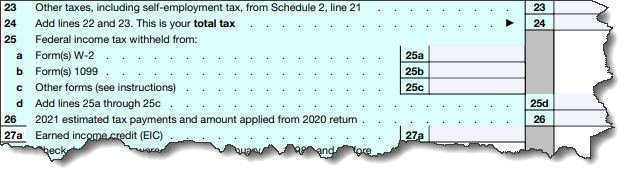
  • You owed no taxes the previous tax year (line 24 on your 2021 1040—total tax—is zero, or you weren’t required to file a return).
  • You were a resident alien or U.S. citizen for all of 2021.
  • Your 2021 tax year covered a 12-month period.

tax tips

You’ll find your total tax for 2021 on line 24 of the Form 1040. Notice, too, that line 26 asks for 2021 estimated tax payments.

There are numerous situations where individuals who have payroll taxes regularly withheld on their income may still be required to submit quarterly estimated taxes. For example, did you receive income from rents or royalties? Dividends or interest? Income from selling an asset? Gambling?

If you have an employer who withholds taxes, but you don’t think you’ll be paying enough given the deductions and credits you might receive, you need to plan for estimated taxes. Self-employed individuals are almost always required to submit them.

Special Rules for Some

As with all things IRS, there are many exceptions to the rules regarding estimated taxes. For example, there are special rules for:

  • Fishermen and farmers.
  • Some household employers.
  • Certain high-income taxpayers.
  • Nonresident aliens.

How Do You Estimate Your Quarterly Taxes?

That’s the hard part, especially if you’re new to the world of estimated taxes. There is no magic formula, no way to calculate to the penny what you’ll owe. You’re basically making an educated guess. Since you won’t know for sure what changes to the tax code will be put in place until the end of the year, you can’t be absolutely certain that you might get a particular credit or deduction.

But you know roughly what your income will be for a given quarter once you’re nearing the end of it. Do you have a lot of business-related expenses? Keeping track of those is critical, as they’ll offset your income. If you don’t, you’ll have to budget for a heftier quarterly payment. And you must keep in mind that you’ll be paying self-employment tax – that portion of your income taxes that your employer used to pay.

Once you’ve been self-employed for a full tax year and have seen what your tax obligation was, it will be easier to estimate in subsequent years. But you may have a difficult time your first year.

How Do You Pay Estimated Taxes?

tax tips

Individuals and business that had to pay estimated taxes in 2021 submitted the Form 1040-ES four times. If you’re self-employed in 2022, you’ll need to submit similar vouchers with your payments, unless you’re paying online.

If you’re self-employed and you anticipate owing $1,000 or more in taxes on your 2022 income, you’ll need to file quarterlies using IRS Form 1040-ES vouchers (available on the IRS website) along with a check or money order. There are also ways to pay online using a credit or debit card or direct bank withdrawal. Corporations would file the Form 1120-W if they expect to owe $500 or more.

Estimated taxes for the 2022 tax year are due:

April 18, 2022 (January 1-March 31, 2022)

June 15, 2022 (April 1-May 31, 2022)

September 15, 2022 (June 1- August 31, 2022)

January 16, 2023 (September 1-December 31, 2022)

A Challenging Task

Estimated taxes are not precise. And it may be difficult to set aside money for them if your income is not where you’d like it to be. But as you might expect, the IRS will levy penalties on you if you don’t.

Year-round tax planning can help you in this critical area. We’ll be happy to set aside time to consult with you about estimated taxes. We’re also available to do tax preparation and to look at how your taxes fit into your overall financial situation. Contact us soon to get a jump on the 2022 tax season — or to finish up 2021.

Filed Under: Business Tax

  • « Previous Page
  • Page 1
  • …
  • Page 6
  • Page 7
  • Page 8
  • Page 9
  • Page 10
  • …
  • Page 13
  • Next Page »

Primary Sidebar

Search

Archives

  • March 2026
  • February 2026
  • January 2026
  • December 2025
  • November 2025
  • October 2025
  • September 2025
  • August 2025
  • July 2025
  • June 2025
  • May 2025
  • April 2025
  • March 2025
  • February 2025
  • January 2025
  • December 2024
  • November 2024
  • October 2024
  • September 2024
  • August 2024
  • July 2024
  • June 2024
  • May 2024
  • April 2024
  • March 2024
  • February 2024
  • January 2024
  • December 2023
  • November 2023
  • October 2023
  • September 2023
  • August 2023
  • July 2023
  • June 2023
  • March 2023
  • February 2023
  • January 2023
  • December 2022
  • November 2022
  • October 2022
  • September 2022
  • August 2022
  • July 2022
  • June 2022
  • May 2022
  • April 2022
  • March 2022
  • February 2022
  • January 2022
  • December 2021
  • November 2021
  • October 2021
  • September 2021
  • August 2021
  • July 2021
  • June 2021
  • May 2021
  • April 2021
  • March 2021
  • February 2021
  • January 2021
  • December 2020
  • November 2020
  • October 2020
  • September 2020
  • August 2020
  • July 2020
  • June 2020
  • May 2020
  • April 2020
  • March 2020
  • February 2020

Categories

  • Best Business Practices
  • Business Tax
  • Estate and Trusts
  • Individual Tax
  • Investment
  • QuickBooks
  • Real Estate Tax
  • Retirement

Copyright © 2022 · https://www.rkncpa.com/blog