• Skip to content
  • Skip to primary sidebar

Header Right

  • Home
  • About
  • Contact

Individual Tax

Make Sure to Not Claim an Ineligible Dependent on Your Taxes

July 17, 2025 by admin

Family income set. Characters planning and bookkeeping budget and household spending. People making savings in piggy bank. Financial management concept. Vector illustration.Claiming dependents on your tax return can significantly reduce your tax liability through exemptions, deductions, and credits. However, claiming an ineligible dependent—whether accidentally or intentionally—can lead to serious consequences, including IRS penalties, delayed refunds, and even audits. Understanding the rules and repercussions is essential for responsible tax filing.

Who Qualifies as a Dependent?

Before diving into the risks of misclaiming, it’s important to understand the criteria the IRS uses to determine dependent eligibility. There are two main categories:

1. Qualifying Child

Must meet all of the following:

  • Relationship: Your child, stepchild, sibling, or descendant.
  • Age: Under 19, or under 24 if a full-time student (no age limit if permanently disabled).
  • Residency: Lived with you for more than half the year.
  • Support: Did not provide more than half of their own financial support.
  • Filing Status: Not filing a joint return (unless only to claim a refund).

2. Qualifying Relative

Must meet all of the following:

  • Not a qualifying child of another taxpayer.
  • Gross Income: Less than the IRS threshold (e.g., $4,700 in 2023).
  • Support: You provided more than half of their support during the year.
  • Relationship or residency: Related to you or lived with you all year.

Common Mistakes That Lead to Claiming Ineligible Dependents

  • Sharing custody: Divorced or separated parents may both try to claim the same child.
  • Adult children: Claiming a child who earned too much or provided most of their own support.
  • Extended family or roommates: Claiming individuals who don’t meet relationship or residency requirements.
  • Double claiming: Both taxpayers in a split household claim the same person.

Consequences of Claiming an Ineligible Dependent

Delayed or Rejected Refund

If the IRS detects a problem (especially if the dependent’s Social Security Number has already been used), your return may be flagged and your refund delayed or denied.

Amended Returns or Audits

You may be required to file an amended return and repay any credits or refunds you received in error. This can trigger an IRS audit, which may require documentation of eligibility.

Penalties and Interest

The IRS can impose penalties for negligence or fraud, along with interest on unpaid taxes.

Loss of Valuable Tax Credits

Claiming an ineligible dependent may incorrectly qualify you for:

  • Child Tax Credit (CTC)
  • Earned Income Tax Credit (EITC)
  • Dependent Care Credit
  • Head of Household status

If disallowed, you may lose eligibility for these credits for up to 10 years if the IRS deems the claim fraudulent.

What to Do If You’ve Made a Mistake

1. Don’t Ignore IRS Notices

If you receive a notice or letter from the IRS about your dependent claim, respond promptly with any requested documentation or corrections.

2. File an Amended Return

Use Form 1040-X to amend your return if you realize you’ve claimed someone who doesn’t qualify. This can reduce penalties if done proactively.

3. Seek Professional Help

A tax professional can help assess your situation and guide you through rectifying the mistake and dealing with the IRS.

Tips to Avoid Errors

  • Use tax preparation software with dependent eligibility checks.
  • Keep thorough records: proof of residency, school records, income, and support documents.
  • Coordinate with other household members or ex-spouses to avoid duplicate claims.

Final Thoughts

Claiming a dependent can offer significant tax benefits, but the rules are strict and must be followed carefully. If you’re unsure whether someone qualifies, it’s better to double-check than risk penalties or audits. When in doubt, consult a licensed tax professional or the IRS website for guidance.

Filed Under: Individual Tax

Maximizing Deductions: Overlooked Tax Deductions You May Be Missing

June 13, 2025 by admin

Indian young man working from home with laptop and bills, holding receipt and looking smilingly at mobile phone screen, checking documents.When tax season rolls around, everyone is looking for ways to reduce their tax bill. One of the most effective strategies for lowering taxable income is to take full advantage of deductions. However, many taxpayers miss out on key deductions simply because they aren’t aware of them or don’t think they qualify. To help ensure you’re not leaving money on the table, here are some commonly overlooked tax deductions that could help reduce your tax liability.

1. Medical Expenses

Did you know that you can deduct certain medical expenses if they exceed a certain percentage of your adjusted gross income (AGI)? For the 2023 tax year, you can deduct qualified unreimbursed medical expenses that are more than 7.5% of your AGI. This includes things like doctor visits, prescription medications, dental treatments, and even travel costs related to medical care. If you have significant medical expenses, keeping track of all receipts and eligible expenses can result in considerable savings.

2. Charitable Donations

Most people know that donations to charity are deductible, but many don’t realize just how much they can deduct. Besides cash contributions, you can also deduct the value of non-cash donations like clothes, furniture, or household items given to qualified organizations. Even out-of-pocket expenses for volunteering, such as mileage or supplies, can be deducted. Just make sure to keep good records and receipts, as the IRS requires documentation for these deductions.

3. Home Office Deduction

If you’re self-employed or run a small business from home, you might qualify for the home office deduction. Many people shy away from claiming this deduction due to fears of an audit, but the IRS offers a simplified option that makes it easy to claim. You can deduct $5 per square foot of your home used exclusively for business, up to a maximum of 300 square feet. Alternatively, if your actual expenses (rent, utilities, and repairs) are greater, you can calculate and deduct the portion of those costs that apply to your home office.

4. Student Loan Interest

If you’re paying off student loans, you may be eligible to deduct up to $2,500 of the interest you paid during the year. This deduction is available even if you don’t itemize, which makes it especially valuable for young professionals just starting out. There are income limits, so be sure to check the IRS guidelines, but for many taxpayers, this can be an easy way to reduce taxable income.

5. State and Local Taxes (SALT) Deduction

The SALT deduction allows taxpayers to deduct up to $10,000 in state and local taxes, including property taxes, state income taxes, and sales taxes. If you live in a state with high taxes, this can provide significant relief. You can choose to deduct either state income taxes or sales taxes, whichever is higher, but not both, so be sure to do the math and see which option benefits you most.

6. Retirement Contributions

Contributing to a traditional IRA or 401(k) not only helps you save for the future but can also reduce your current-year taxable income. Contributions to these retirement accounts are tax-deductible up to certain limits, and the savings can add up quickly. For 2023, you can contribute up to $6,500 to an IRA, or $7,500 if you’re age 50 or older. For 401(k)s, the contribution limit is $22,500 ($30,000 if you’re over 50). These contributions lower your taxable income, meaning you pay less in taxes now while saving for retirement.

7. Job Search Expenses

If you’re searching for a new job in your current occupation, you may be able to deduct some of the costs associated with the search, even if you don’t land the job. Eligible expenses include things like resume preparation, travel costs to interviews, and job placement fees. Keep in mind that these expenses must be itemized, and they are subject to the 2% AGI rule, which means only the amount of your total miscellaneous deductions that exceeds 2% of your AGI is deductible.

8. Educator Expenses

If you’re a teacher, you probably spend some of your own money on classroom supplies. The good news is that you can deduct up to $300 of unreimbursed expenses (or $600 if both you and your spouse are educators). This can include things like books, classroom materials, and even professional development courses.


Conclusion

Maximizing your deductions is one of the best ways to lower your tax bill, but it requires careful planning and documentation. By being aware of commonly overlooked deductions, you can ensure you’re getting every tax break available to you. Remember, tax laws can be complex, and everyone’s financial situation is different, so it’s always a good idea to consult with a tax professional to make sure you’re maximizing your deductions and minimizing your tax liability.

Filed Under: Individual Tax

Help Your Working Teen Get a Jump-Start on Saving

March 7, 2024 by admin

Happy family watching funny video on laptop together with their adopted daughter during leisure time at homeYou may have a teen in your family who holds down a part-time job or works full-time during the summer. You can help your child lay the groundwork for future retirement security early on by encouraging your child to open an individual retirement account (IRA).

You may, or may not, get some resistance, especially if your child has other plans for spending the money. However, you should persist since the benefits can be significant over the long term. Here are some points you can bring up as you make your case.

Savings Can Grow Over Time

When it comes to building savings, your child’s age is a major advantage. Given enough time, even a relatively small investment could grow into a significant sum due to the power of compounding. For example, a one-time investment of $6,000 could grow to $110,521 in 50 years, assuming a hypothetical 6% annual return. Invest $6,000 every year for 50 years at 6%, and your child could accumulate over $1.7 million. Of course, investment returns can vary from year to year and are not guaranteed.

IRAs Offer Tax Advantages

As long as your teen does not participate in an employer’s retirement plan, contributions to a traditional IRA will be fully tax deductible. (With plan participation, income limits may apply.) Any earnings that investments in the IRA make will grow tax deferred. Your child won’t have to pay any income taxes on the IRA funds until they are withdrawn from the IRA.

Contributions to a Roth IRA are not tax deductible, but they can be withdrawn tax free at any time for any purpose. Earnings accumulate tax deferred and can be withdrawn tax free once your child reaches age 59½ and has had a Roth IRA for at least five tax years. Tax-free withdrawals are also available after five years for first-time home buying expenses (to a maximum of $10,000) or on account of disability or death.

Your teen can contribute up to $6,500 to one or more IRAs in 2023 or the amount of his or her annual compensation, if less. The IRS adjusts this IRA contribution limit periodically for inflation. Your child has until the April tax-filing deadline to contribute to an IRA for the prior tax year.

If you would like some help deciding which type if IRA may make the most sense for your teen child, be sure to get in touch with your financial professional.

Filed Under: Individual Tax

Tips on Tax Planning

September 21, 2023 by admin

Monthly cost or budget, expense to pay bill, mortgage or debt, plan for savings or investment, money management or credit card payment, smart woman plan her monthly budget with calendar and piggybank.You may not think about taxes often, but they can prove to be a large expense. That’s why it’s important to make the most of any opportunities you may have to lower your tax liability. Here’s a look at some of the factors you may want to consider in your planning.

Standard Deduction or Itemizing

The Tax Cuts and Jobs Act (TCJA) contained many provisions that will be in place through the 2025 tax year. For example, there are significantly higher standard deductions for each filing status and various itemized deductions have been reduced or eliminated. As a result, many people who previously itemized are now better off taking the standard deduction. But don’t automatically rule out itemizing, especially if you expect to make a large charitable contribution or will have a lot of medical and dental expenses. By bunching these items in one tax year, to the extent possible, you may have enough to make itemizing worthwhile that year.

Home/Work Tax Breaks

If you are a traditional full-time employee and work from home, home office expenses are not deductible, even if you itemize. The deduction for unreimbursed employee business expenses (and various other miscellaneous expenses) won’t be restored until 2026. However, if you are a self-employed/gig worker, you may qualify to deduct your home office expenses. Certain requirements apply.

Moving Expenses

Work-related moving expenses may now be deducted only if you are an active-duty member of the Armed Forces and the move is per a military reassignment. This deduction is available whether you itemize or claim the standard deduction.

Health Savings Accounts (HSAs)

HSAs continue to offer tax breaks. If you are covered by a qualified high-deductible health plan and meet other requirements, you can contribute pretax income to an employer-sponsored HSA or make deductible contributions to an HSA you open on your own. An HSA can earn interest or be invested, growing in a tax-deferred manner similar to an individual retirement account (IRA). And HSA withdrawals for qualified medical expenses are tax free. You can also carry over a balance from year to year, allowing the account to grow.

Family Related Tax Credits

The TCJA expanded tax credits for families, doubling the child credit and adding a family credit for dependents who don’t qualify for the child credit. Credits include one for each child under age 18 at the end of the tax year and another for each qualifying dependent who isn’t a qualifying child. The latter category includes an older dependent child or a dependent elderly parent.

The adoption credit and the income exclusion for employer adoption assistance are still in place. You’ll want to check into the details if you are adopting a child.

Section 529 Plans*

These tax-advantaged savings plans assist in paying for education. While initially used to pay for a college education, 529 plans may now cover elementary through high school education as well. Some states offer tax breaks for 529 plan contributions. However, contributions are not deductible on your federal return. Growth related to 529 contributions is tax deferred, and withdrawals for qualified education expenses — including elementary and secondary school tuition of up to $10,000 per year per student — are free of federal income taxes.

A special break allows you to front-load five years’ worth of gift tax annual exclusions and make up to a $85,000 contribution per beneficiary in one tax year free of federal gift tax. If you make the contribution with your spouse, the total can be extended to $170,000. (These limits may be inflation adjusted.)

Other Education Tax Breaks

As before, you may be able to take advantage of either the American Opportunity credit or the Lifetime Learning credit for higher education costs. The first credit can be up to $2,500 per student per year for the first four years of college. The second credit is limited to $2,000 per tax return and is available for qualified expenses of any post-high school education at an eligible educational institution, including graduate school.

In addition, if you are paying off your student loans, you may be able to deduct the interest, up to $2,500 per year. This deduction is available whether you claim the standard deduction or itemize.

Keep in mind that there are income limits for these tax breaks.

Investments

To help reduce the taxes you pay on investment gains in taxable accounts, you may want to consider:

  • Selling securities with unrealized losses before year end to offset realized capital gains.
  • Choosing mutual funds** with low portfolio turnover rates that tend to generate long-term capital gains, since the lower long-term rates offer a tax savings.
  • Factoring in that you can deduct only $3,000 of net capital losses per year against other income ($1,500 if you’re married filing separately), but you can carry forward excess losses to subsequent tax years.

You should also be aware that if you have modified adjusted gross income of over $200,000 ($250,000 if married filing jointly; $125,000 if married filing separately), you may owe a 3.8% “net investment income tax,” or NIIT.

Retirement

While the TCJA made only minimal changes in the area of retirement planning, there are still issues to consider. The main one is whether you want to pay taxes on your retirement account contributions later (when you eventually take distributions from your account) or pay taxes on them now (which means potentially tax-free distributions when you retire). It all depends on the type of savings vehicle you use.

Traditional 401(k), 403(b), and 457 plans and traditional IRAs allow you to save for retirement on a tax-deferred basis. Your employer may also choose to make contributions to your plan account. Salary deferrals to 401(k) and similar plans are generally pretax, while traditional IRA contributions are tax deductible under certain circumstances.

Roth alternatives — available in some employers’ 401(k), 403(b), and 457 plans, as well as through a Roth IRA you open on your own — provide no tax break on contributions. However, investment earnings accumulate tax deferred. And, when requirements are met, distributions from your account are tax free. Since Roth accounts in employer plans lack income restrictions, you may be able to make larger contributions to an employer’s Roth plan than to a Roth IRA.

As always, make sure that you obtain professional advice before making tax-related decisions. Your tax professional can provide detailed information and help you evaluate what might be appropriate for your personal tax situation.

Filed Under: Individual Tax

Can’t Pay Your Income Taxes? Some Solutions

May 23, 2022 by admin

Two Businesswomen Meeting In OfficeDid you skip filing or request an extension on your 2021 taxes because you couldn’t pay? You have several options.
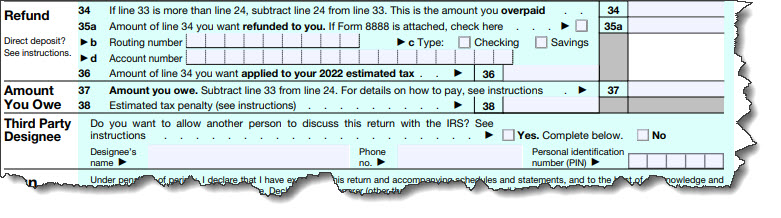
It’s happened to many people at one time or another. You wait until the last minute to prepare and file your income taxes, only to receive a very unpleasant surprise: You owe money, and you don’t have it to give. Even if you file for an extension, the IRS still expects you to send in what you estimate you’ll owe. If that’s absolutely impossible, you should always try to send in what you can.

The first thing you should do, of course, is to review your 1040 again. Did you take all of the credits and deductions that you should have? Or make any calculation errors? Did you somehow overstate your income?

If after checking your return you still see that large number on line 37 (Amount you owe), try not to despair. And certainly, don’t neglect to file. Instead, take advantage of one of the many options you have.

tax tips

If you have to enter a big number on line 37 and you lack the funds to pay the IRS, there are several different steps you can take.

Try to Get a Loan

This is the best solution if it’s possible. Consider approaching family members who you know might have enough disposable income to help you out temporarily. If that’s not possible, check with your bank or credit union or online lenders. Paying interest may be more economical than dealing with IRS penalties and interest – and less harmful to your tax-paying history.

Set Up an Online Payment Plan

If you qualify (and most individual taxpayers do), you can set up an online payment plan through the IRS itself. You don’t have to contact the agency. It can all be done on the web. Once you’ve provided the required information, you’ll be notified immediately about your approval status. There are two types:

  • Short-term payment plan. This is designed for taxpayers who owe less than $100,000 and are going to repay it in 180 days or fewer. Keep in mind that the late-payment penalty and interest will continue to accrue, so those amounts have to be figured into your plan. There are no other fees for this.
  • Long-term payment plan. This is also known as an installment agreement, and it usually involves a setup fee, though low-income individuals might be able to have the fee waived or reimbursed. Your total debt to the IRS must be less than $50,000 (combined tax, interest, and penalties), and you’re required to make monthly payments. If you filed your return on time, your late-payment penalty will be reduced from up to 1 percent per month to 0.25 percent per month for as long as the installment agreement is in effect.

Offer in Compromise

It may be possible for you to settle your tax bill with the IRS and pay less than what you originally owed. There is a non-refundable fee of $200 that is generally waived for low-income taxpayers. You can see if you’re eligible by visiting this site and completing the multi-step questionnaire.

tax tips

You can use this IRS tool to see if you pre-qualify for an Offer in Compromise, which could reduce your tax bill

Delayed Collection

If you are absolutely unable to pay and the IRS can confirm this, the agency may delay collection until your finances improve. Call the number on your notice to request this action, or call (800) 829-1040. Interest and penalties will continue to accrue during the delay.

Penalty Relief

You may also be able to get your late-payment penalties reduced or eliminated if you have reasonable cause, as defined by the IRS. The agency decides whether you’re eligible for this on a case-by-case basis. If you have a solid history of compliance, the First Time Abatement program may be available to you.

Planning Ahead Helps

It’s good to know that there are options if you can’t come up with enough money to pay your tax bill, but you can probably avoid that situation if you do year-round tax planning. Looking at your income and expenses—especially the major ones—in terms of their effect on your taxes can go a long way toward avoiding surprises at filing time. Let us know if we can help you develop such a strategy.

Filed Under: Individual Tax

Tax Planning Tips for Individuals

January 12, 2022 by admin

Businesswoman working at the officeYou may not think about taxes often, but they can prove to be a large expense. That’s why it’s important to make the most of any opportunities you may have to lower your tax liability. Here’s a look at some of the factors you may want to consider in your planning.

Standard Deduction or Itemizing

The Tax Cuts and Jobs Act (TCJA) contained many provisions that will be in place through the 2025 tax year. For example, there are significantly higher standard deductions for each filing status and various itemized deductions have been reduced or eliminated. As a result, many people who previously itemized are now better off taking the standard deduction. But don’t automatically rule out itemizing, especially if you expect to make a large charitable contribution or will have a lot of medical and dental expenses. By bunching these items in one tax year, to the extent possible, you may have enough to make itemizing worthwhile that year.

Home/Work Tax Breaks

If you are a traditional full-time employee and work from home, home office expenses are not deductible, even if you itemize. The deduction for unreimbursed employee business expenses (and various other miscellaneous expenses) won’t be restored until 2026. However, if you are a self-employed/gig worker, you may qualify to deduct your home office expenses. Certain requirements apply.

Moving Expenses

Work-related moving expenses may now be deducted only if you are an active-duty member of the Armed Forces and the move is per a military reassignment. This deduction is available whether you itemize or claim the standard deduction.

Health Savings Accounts (HSAs)

HSAs continue to offer tax breaks. If you are covered by a qualified high-deductible health plan and meet other requirements, you can contribute pretax income to an employer-sponsored HSA or make deductible contributions to an HSA you open on your own. An HSA can earn interest or be invested, growing in a tax-deferred manner similar to an individual retirement account (IRA). And HSA withdrawals for qualified medical expenses are tax free. You can also carry over a balance from year to year, allowing the account to grow.

Family Related Tax Credits

The TCJA expanded tax credits for families, doubling the child credit and adding a family credit for dependents who don’t qualify for the child credit. Credits include one for each child under age 17 at the end of the tax year (under age 18 for 2022) and another for each qualifying dependent who isn’t a qualifying child. The latter category includes an older dependent child or a dependent elderly parent.

The adoption credit and the income exclusion for employer adoption assistance are still in place. You’ll want to check into the details if you are adopting a child.

Section 529 Plans*

These tax-advantaged savings plans assist in paying for education. While initially used to pay for a college education, 529 plans may now cover elementary through high school education as well. Some states offer tax breaks for 529 plan contributions. However, contributions are not deductible on your federal return. Growth related to 529 contributions is tax deferred, and withdrawals for qualified education expenses — including elementary and secondary school tuition of up to $10,000 per year per student — are free of federal income taxes.

A special break allows you to front-load five years’ worth of gift tax annual exclusions and make up to a $80,000 contribution per beneficiary in one tax year free of federal gift tax. If you make the contribution with your spouse, the total can be extended to $160,000. (These limits may be inflation adjusted.)

Other Education Tax Breaks

As before, you may be able to take advantage of either the American Opportunity credit or the Lifetime Learning credit for higher education costs. The first credit can be up to $2,500 per student per year for the first four years of college. The second credit is limited to $2,000 per tax return and is available for qualified expenses of any post-high school education at an eligible educational institution, including graduate school.

In addition, if you are paying off your student loans, you may be able to deduct the interest, up to $2,500 per year. This deduction is available whether you claim the standard deduction or itemize.

Keep in mind that there are income limits for these tax breaks.

Investments

To help reduce the taxes you pay on investment gains in taxable accounts, you may want to consider:

  • Selling securities with unrealized losses before year end to offset realized capital gains.
  • Choosing mutual funds** with low portfolio turnover rates that tend to generate long-term capital gains, since the lower long-term rates offer a tax savings.
  • Factoring in that you can deduct only $3,000 of net capital losses per year against other income ($1,500 if you’re married filing separately), but you can carry forward excess losses to subsequent tax years.

You should also be aware that if you have modified adjusted gross income of over $200,000 ($250,000 if married filing jointly; $125,000 if married filing separately), you may owe a 3.8% “net investment income tax,” or NIIT.

Retirement

While the TCJA made only minimal changes in the area of retirement planning, there are still issues to consider. The main one is whether you want to pay taxes on your retirement account contributions later (when you eventually take distributions from your account) or pay taxes on them now (which means potentially tax-free distributions when you retire). It all depends on the type of savings vehicle you use.

Traditional 401(k), 403(b), and 457 plans and traditional IRAs allow you to save for retirement on a tax-deferred basis. Your employer may also choose to make contributions to your plan account. Salary deferrals to 401(k) and similar plans are generally pretax, while traditional IRA contributions are tax deductible under certain circumstances.

Roth alternatives – available in some employers’ 401(k), 403(b), and 457 plans, as well as through a Roth IRA you open on your own – provide no tax break on contributions. However, investment earnings accumulate tax deferred. And, when requirements are met, distributions from your account are tax free. Since Roth accounts in employer plans lack income restrictions, you may be able to make larger contributions to an employer’s Roth plan than to a Roth IRA.

As always, make sure that you obtain professional advice before making tax-related decisions. Your tax professional can provide detailed information and help you evaluate what might be appropriate for your personal tax situation.

Source/Disclaimer:

*Certain 529 plan benefits may not be available unless specific requirements (e.g., residency) are met. There also may be restrictions on the timing of distributions and how they may be used.Before investing, consider the investment objectives, risks, and charges and expenses associated with municipal fund securities. The issuer’s official statement contains more information about municipal fund securities, and you should read it carefully before investing.

**You should consider a fund’s investment objectives, charges, expenses, and risks carefully before you invest. The fund’s prospectus, which can be obtained from your financial representative, contains this and other information about the fund. Read the prospectus carefully before you invest or send money. Shares, when redeemed, may be worth more or less than their original cost.

This communication is not intended to be tax advice and should not be treated as such. Each individual’s tax circumstances are different. You should contact your tax professional to discuss your personal situation.

Filed Under: Individual Tax

  • Page 1
  • Page 2
  • Next Page »

Primary Sidebar

Search

Archives

  • January 2026
  • December 2025
  • November 2025
  • October 2025
  • September 2025
  • August 2025
  • July 2025
  • June 2025
  • May 2025
  • April 2025
  • March 2025
  • February 2025
  • January 2025
  • December 2024
  • November 2024
  • October 2024
  • September 2024
  • August 2024
  • July 2024
  • June 2024
  • May 2024
  • April 2024
  • March 2024
  • February 2024
  • January 2024
  • December 2023
  • November 2023
  • October 2023
  • September 2023
  • August 2023
  • July 2023
  • June 2023
  • March 2023
  • February 2023
  • January 2023
  • December 2022
  • November 2022
  • October 2022
  • September 2022
  • August 2022
  • July 2022
  • June 2022
  • May 2022
  • April 2022
  • March 2022
  • February 2022
  • January 2022
  • December 2021
  • November 2021
  • October 2021
  • September 2021
  • August 2021
  • July 2021
  • June 2021
  • May 2021
  • April 2021
  • March 2021
  • February 2021
  • January 2021
  • December 2020
  • November 2020
  • October 2020
  • September 2020
  • August 2020
  • July 2020
  • June 2020
  • May 2020
  • April 2020
  • March 2020
  • February 2020

Categories

  • Best Business Practices
  • Business Tax
  • Estate and Trusts
  • Individual Tax
  • Investment
  • QuickBooks
  • Real Estate Tax
  • Retirement

Copyright © 2022 · https://www.rkncpa.com/blog