
• Skip to content
  • Skip to primary sidebar

Header Right

  • Home
  • About
  • Contact

Business Tax

Starting a Side Gig in 2022? Your New Tax Obligations

February 15, 2022 by admin

Tax wording on wooden cubes with US dollar coins and bag.It’s not just self-employed individuals who must pay estimated taxes. Here’s what you need to know.

W-2 income tax withholding isn’t perfect. You’ve probably had years when you owed more than you expected to on April 15. Or you were pleasantly surprised to receive a sizable refund. The idea, of course, is to try to come out as even as possible. You can usually do this by adjusting your withholding when you experience a life change like taking on a mortgage or having a baby.

Income taxes are also pay-as-you-go for self-employed individuals – or at least they should be. If you’re striking out on your own by starting your own small business in 2022 or you’re simply taking on a side gig to improve your finances, your tax obligation will change dramatically. Your income will not be subject to employer withholding every week or two. In most cases, you’ll get it all. But the IRS expects you to pay estimated taxes on that income four times a year.

Who Else Must Pay?

There are other situations where you’ll be expected to make quarterly payments. In fact, the only individuals who aren’t required to pay estimated taxes (besides W-2 employees whose withholding is on target) are those who meet all three of these conditions:

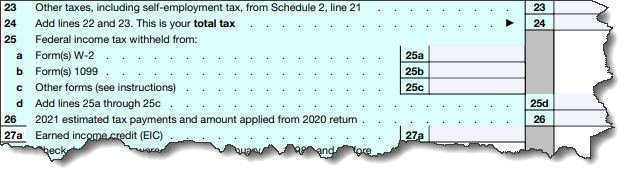
  • You owed no taxes the previous tax year (line 24 on your 2021 1040—total tax—is zero, or you weren’t required to file a return).
  • You were a resident alien or U.S. citizen for all of 2021.
  • Your 2021 tax year covered a 12-month period.
tax tips

You’ll find your total tax for 2021 on line 24 of the Form 1040. Notice, too, that line 26 asks for 2021 estimated tax payments.

There are numerous situations where individuals who have payroll taxes regularly withheld on their income may still be required to submit quarterly estimated taxes. For example, did you receive income from rents or royalties? Dividends or interest? Income from selling an asset? Gambling?

If you have an employer who withholds taxes, but you don’t think you’ll be paying enough given the deductions and credits you might receive, you need to plan for estimated taxes. Self-employed individuals are almost always required to submit them.

Special Rules for Some

As with all things IRS, there are many exceptions to the rules regarding estimated taxes. For example, there are special rules for:

  • Fishermen and farmers.
  • Some household employers.
  • Certain high-income taxpayers.
  • Nonresident aliens.

How Do You Estimate Your Quarterly Taxes?

That’s the hard part, especially if you’re new to the world of estimated taxes. There is no magic formula, no way to calculate to the penny what you’ll owe. You’re basically making an educated guess. Since you won’t know for sure what changes to the tax code will be put in place until the end of the year, you can’t be absolutely certain that you might get a particular credit or deduction.

But you know roughly what your income will be for a given quarter once you’re nearing the end of it. Do you have a lot of business-related expenses? Keeping track of those is critical, as they’ll offset your income. If you don’t, you’ll have to budget for a heftier quarterly payment. And you must keep in mind that you’ll be paying self-employment tax – that portion of your income taxes that your employer used to pay.

Once you’ve been self-employed for a full tax year and have seen what your tax obligation was, it will be easier to estimate in subsequent years. But you may have a difficult time your first year.

How Do You Pay Estimated Taxes?

tax tips

Individuals and business that had to pay estimated taxes in 2021 submitted the Form 1040-ES four times. If you’re self-employed in 2022, you’ll need to submit similar vouchers with your payments, unless you’re paying online.

If you’re self-employed and you anticipate owing $1,000 or more in taxes on your 2022 income, you’ll need to file quarterlies using IRS Form 1040-ES vouchers (available on the IRS website) along with a check or money order. There are also ways to pay online using a credit or debit card or direct bank withdrawal. Corporations would file the Form 1120-W if they expect to owe $500 or more.

Estimated taxes for the 2022 tax year are due:

April 18, 2022 (January 1-March 31, 2022)

June 15, 2022 (April 1-May 31, 2022)

September 15, 2022 (June 1- August 31, 2022)

January 16, 2023 (September 1-December 31, 2022)

A Challenging Task

Estimated taxes are not precise. And it may be difficult to set aside money for them if your income is not where you’d like it to be. But as you might expect, the IRS will levy penalties on you if you don’t.

Year-round tax planning can help you in this critical area. We’ll be happy to set aside time to consult with you about estimated taxes. We’re also available to do tax preparation and to look at how your taxes fit into your overall financial situation. Contact us soon to get a jump on the 2022 tax season — or to finish up 2021.

Filed Under: Business Tax

Avoiding Capital Gains Taxes with a 1031 Exchange

September 20, 2021 by admin

Savvy investors can build wealth by deferring capital gains taxes via a 1031 exchange. Learn how it works and how it can help you as a real estate investor. For the in-depth information required to execute a 1031 exchange, a qualified intermediary is necessary.

What is a 1031 Exchange?

A 1031 exchange allows real estate investors to avoid paying capital gains taxes when selling an investment property and reinvesting in a replacement property. The name 1031 exchange comes from Section 1031 of the U.S. Internal Revenue Code.

A 1031 is also called a like-kind exchange. It is essentially a swap of one investment property for another. The “like-kind” refers to the fact that the properties in the exchange must be similar (i.e., of like kind) and the exchange property must be of equal or greater value as the property sold.

How Does a 1031 Exchange Work?

Under IRS code section 1031, which applies to real estate, investors can reinvest proceeds from the sale of one property into another property within a specified time frame to avoid paying capital gains taxes (the taxes on the growth of an investment when it is sold). Because it is rare for an even property swap to occur between parties, the most common type of exchange is the delayed “forward” exchange. In this case, the sold property funds are sent to a qualified intermediary and later used to acquire a replacement property from a seller.

What is a Qualified Intermediary?

A qualified intermediary facilitates a 1031 exchange. They hold the transaction funds from the sale of the first property until those funds are transferred to the seller of a replacement property. The qualified intermediary also prepares the legal documents required for the exchange. The qualified intermediary can have no formal relationship with the exchange parties outside of the exchange.

1031 Exchange Important Deadlines

  • The seller of the first property (the relinquished property) must identify a replacement property (their new investment property) within 45 days of the transfer of the relinquished property.
  • The replacement property must be received by the exchanger within either (1) 180 days of the date the exchanger transferred the first Relinquished Property or (2) the due date of the exchanger’s tax return for the year that the transfer of the first relinquished property occurs.
  • These are strict timelines and are not extended even if the 45th or 180th days fall on a weekend or holiday.

What You Need to Know about a 1031 Exchange

1031 exchange transactions should be handled by a professional qualified intermediary that is a third party (i.e., not a family member, friend, acquaintance, or business associate of either party involved in the exchange).

Exceptions

The IRS does not allow capital gains tax avoidance if the exchange:

  • is U.S. real estate for real estate in another country
  • involves property for personal use
  • is between related parties and either disposes of the property within two years

Why Do Investors Use a 1031 Exchange?

  • They can use what they would have paid in capital gains taxes to put more down on a replacement property to improve their buying power.
  • The savings on federal capital gains taxes could be 15 to 20 percent.
  • There could be savings at the state level (this varies by state, so your qualified intermediary should be consulted for this information).
  • The amount of income taxes paid could be reduced due to depreciation of the investment property.

A 1031 exchange is a tool that savvy real estate investors use to build wealth over time. To further understand how a 1031 exchange can benefit you, ask your CPA or accountant to help put you in touch with a qualified intermediary. Their guidance is critical in executing a 1031 whether you’re swapping two properties or working with a full portfolio of investment real estate properties.


Filed Under: Business Tax

The Top 5 Ways Businesses Get in Trouble With the IRS

May 20, 2021 by admin

stressed out person because of irsAs a small business owner, you probably know that willfully avoiding paying taxes will lead to severe problems with the IRS; however, IRS problems aren’t always a result of a business owner’s intentional actions. These are five ways business owners can get into trouble with the IRS that they might overlook or not realize.

1. Under-Reporting Income

All business income must be reported to the IRS. Even if you are a freelancer, receive contract payments, or are paid in cash, you must let the IRS know or risk hefty fines and penalties on top of the tax you owe on that income. Some individual self-employed people fail to pay taxes – either due to lack of knowledge about tax laws or evasion – and do not realize they are responsible for up to six years of back tax returns. Take note that if you do need to file back tax returns, many deductions are not claimable on more than the most recent three returns. Additional years, up to six, must be filed; however, the benefit of deductions is lost beyond three years.

2. Over-Reporting Expenses

Keep business expenses separate, preferably paid from a separate account and with a separate credit card, so that your expenses do not get mixed in with those for your business. The most common over-reported expenses are private travel being claimed and business travel and private miles driven and claimed as business miles. If you’re not sure what qualifies as an actual business expense, consult with your tax preparer or accountant. For a business expense to be deductible, it must be ordinary and necessary. An “ordinary” expense is common and accepted in your business; a “necessary” expense is helpful and appropriate for your business. Expenses like the cost of goods sold (for manufacturing businesses) and capital expenses (costs that are part of your investment in your business) are figured separately from business expenses.

3. Failing to Report “Trust Fund Taxes”

As an employer, you must withhold taxes from employee earnings. Those taxes are not paid to employees as wages and are held “in trust” until paid to the U.S. Treasury. Thus, the name “trust fund taxes.” These are income tax, Social Security, and Medicare taxes (aka “withholdings”). Sales tax is also considered a “trust fund” tax since it is collected from someone else like a customer or client and held until paid to the Treasury. These taxes must be paid and reported to the proper taxing authority and cannot be used for operating or financing a business. If they are, and they are not reported, it is considered tax fraud.

4. Forgetting the Self-Employment Tax

Just like an employer must withhold Social Security and Medicare taxes from employees, if you are self-employed, you must pay self-employment (SE) tax, consisting of Social Security and Medicare taxes, to the Treasury. The SE tax is 15.3 percent (12.4 percent for social security (old-age, survivors, and disability insurance) and 2.9 percent for Medicare (hospital insurance) of net self-employment income in addition to income taxes. That means it is calculated after expenses are deducted. Note that SE tax does not include any other taxes that self-employed individuals may be required to file, so these individuals must consult their tax preparer or accountant to be sure they are paying all the required taxes. Also, self-employed individuals can deduct the employer-equivalent portion of the SE tax when calculating their adjusted gross income (AGI). Also, keep in mind that the tax is paid only on net self-employment earnings, that is, income after expenses are deducted.

5. Not Paying Estimated Quarterly Taxes

As a small business owner, you do not have taxes withheld from a formal paycheck as wage-earning employees do. However, that does not mean there are no taxes due to the IRS. If a small business owner anticipates a tax liability of $1,000 or more, they must send estimated quarterly tax payments to the IRS. Not doing so can lead to a whopping end-of-year tax bill with penalties, too.


We’ll work hard to resolve your IRS tax problems! Don’t prolong the stress and anxiety about back taxes, tax penalties, and mounting interest. Call us today at 703-971-2422 or request a free consultation online right now.

Filed Under: Business Tax

Business Meals are Deductible Again: Here’s What You Need to Know

April 21, 2021 by admin

Three Businesspeople Having Meeting In Outdoor RestaurantThe Consolidated Appropriations Act of 2021 brings a favorite business tax deduction back to life. The so-called “three-martini lunch” is in vogue once again; however, not everyone is happy about it. So, what does this mean for businesses? Read on to learn more about the deduction and the associated pros and cons.

What is the Three-Martini Lunch Tax Deduction?

There was a time – up until the mid-1980s – that business owners and executives could take a 100 percent tax deduction for entertaining clients, colleagues, or even themselves (as it was not unheard of for personal expenses to be grouped in with “business expenses”).

The somewhat scoffing name of the deduction – the Three-Martini Lunch – comes from these lavish “business expenses” that sometimes included leisurely lunches (complete with cocktails), rounds of golf, sporting event tickets, and even vacations. However, under tax laws at the time, as long as the activities were conducted in the name of entertaining clients, they could be deducted on a business’ federal return.

What Changed?

The Tax Reform Act of 1986 eliminated or significantly reduced many tax deductions, including putting a severe halt to businesses’ total deductions for entertaining potential or current clients. Beginning in 1987, the business meal deduction decreased from 100 to 80 percent. Further, the Act called for any part of the meal that was considered “lavish and extravagant” to be excluded from the amount used to calculate the deduction (although no accurate guidance was provided on what constituted “lavish and extravagant”).

Over the years, the deduction was further reduced, and finally, the Tax Cuts and Jobs Act (TCJA) of 2017 repealed the entertainment allowance and scaled the business meal deduction down to 50 percent. The deduction applied only to expenses encountered during actual business activities or active discussions.

Of course, there were caveats and loopholes associated with the changes; however, those loopholes no longer seem necessary as, after more than 30 years, the 100 percent deduction is restored. This increase is due to the Taxpayer Certainty and Disaster Tax Relief Act of 2020, part of the Consolidated Appropriations Act of 2021 (CAA 2021).

The Consolidated Appropriations Act of 2021

Championed by the White House and Senator Tim Scott, a Republican from South Carolina, the Act increases the deduction to 100 percent so that businesses can deduct the total cost of business meals on federal taxes. This increase in deduction occurred by way of an amendment to the Tax Reform Act of 1986 that makes an exception to the 50 percent rule until January 1, 2023.

What You Should Know

For expenses to be fully deductible, they must be paid or incurred during 2021 or 2022, and the food and beverages claimed must be provided by a restaurant. The Act does not explicitly apply this full deduction to entertainment expenses. Intended to help the flailing restaurant industry during the global pandemic, the Act leaves many business personnel with questions. For example, what constitutes a “restaurant”? (this is not clearly defined in the IRS code).

For some guidance, Section 4.01 of Part III of the IRS procedural guide for taxpayers who own or operate a restaurant or tavern deems a “restaurant” to be a place where “food and beverages are prepared to customer order for immediate on-premises or off-premises consumption. Examples are full-service restaurants, limited-service eating places, cafeterias, special food services (like food service contractors, caterers, and mobile food services), and bars, taverns, and other drinking places.”

Another question taxpayers are asking is how should non-food and beverage expenses be handled? (there is no accurate guidance on entertainment expenses).

As you consider these and other questions regarding the new deduction guidelines, also consider some of the proposed pros and cons of the ruling.

Pros and Cons of the Three-Martini Lunch

Returning to a full deduction for business meals and entertainment has been praised and criticized regarding how the change will impact businesses and the economy in general.

Some suggested benefits include:

  • An increase in business will help restaurants and bars reopen in the time of the global pandemic.
  • New employment for those out of work and reemployment for furloughed food service employees.
  • A limited-time (two-year) action to bolster the foodservice industry during the pandemic.

Some of the criticisms of the Act are that:

  • This deduction robs tax relief funds that are more important.
  • It could be challenging to eliminate the deduction when the two-year limit comes.
  • The benefit will extend only to the wealthy who do not need immediate tax relief.
  • Only large, high-end restaurants that serve wealthy business clientele will benefit.

These and other points of interest – as well as many questions – will likely arise as the tax year unfolds. To address these, it is always best for business owners to consult with a tax professional.

From small businesses to individuals, our Fairfax, VA CPA firm applies the same level of dedication to every client, with sound tax strategies and unsurpassed attention to detail. Call our office now at 703-971-2422 to discover how we can decrease your tax obligations. We welcome new clients and offer a free consultation so contact us today.

Filed Under: Business Tax

5 Ways to Lower Your SUTA Tax Rate

August 20, 2020 by admin

Text sign showing Tax Tips. Conceptual photo Help Ideas for taxation Increasing Earnings Reduction on expenses Concept For InformationAn employer’s SUTA tax rate is susceptible to fluctuation. If yours is escalating, contrary to popular belief, you actually might be able to reduce it! Check out these five strategies to curb your SUTA tax rate.

Because the State Unemployment Tax Act – or SUTA – tax is mandatory, you may think you have no control over your SUTA rate. But to some extent, you do. The first thing to remember is that each state sets its own criteria for state unemployment tax, and rates vary by employer.

Typically, new employers are assigned a standard “new employer” rate. Over time, they receive an “experience rating,” which can be higher or lower than the new employer rate. The experience rating mainly depends on how many former employees have drawn unemployment benefits on the employer’s account. The more benefits claimed on an employer’s account, the higher its SUTA tax rate. Other determinants may include whether the employer is in the construction industry and the employer’s payroll size.

You may be powerless against some of these influencers – such as your business’s age and industry — but there are other ways to lower your SUTA rate. Here are five tactics.

1. Hire only when needed

Letting employees go because you don’t need them anymore likely renders them eligible for unemployment benefits. If they file for unemployment benefits, your SUTA rate is likely to increase. So, make sure you truly need an employee before hiring him or her.

2. Help your employees succeed

Employees terminated for gross misconduct typically do not qualify for unemployment benefits. However, employees fired for poor performance – such as due to lack of skills – may be eligible. To reduce the likelihood of terminating employees for poor performance, give them the resources they need to succeed, including proper tools and training.

3. Use independent contractors

You can avoid unemployment claims by legally hiring independent contractors instead of employees. If you decide to take this route, ensure all mandatory requirements for independent contractor status are met, including the Internal Revenue Service’s “right-to-control” test and applicable state tests.

4. Contest dubious unemployment claims

Dubious unemployment claims may involve former employees providing the state workforce agency with false information to obtain benefits or filing a claim even though they were rightfully terminated for gross misconduct. Before you fight an unemployment claim, consult with an unemployment benefits expert to gauge the strength of your case. Also, make sure you have supporting documents to back up your version of events.

5. Make voluntary contributions

Many states allow employers with an experience rating to voluntarily make a “buydown” payment, which cancels all or part of the benefits charged to their account, thereby reducing their SUTA tax rate.

More tips

Consider alternatives to layoffs, such as reducing employees’ work hours via your state’s work-sharing program.

Offer departing employees a solid severance package as well as outplacement services to help them quickly find a job. This way, they will be less inclined to rely on unemployment benefits.

Keep an eye on your SUTA tax rate. If it’s spiking for unknown reasons, contact your state’s workforce agency for an explanation.

Find out how we can use our wealth of knowledge, proven accounting strategies, and impeccable organizational skills to manage your accounting. Call 703-971-2422 to schedule your free consultation now.

Filed Under: Business Tax

“Extender” Legislation Impacts Individuals and Small Businesses

July 31, 2020 by admin

Business team analyzing market researchThe federal spending package that was enacted in the waning days of 2019 contains numerous provisions that will impact both businesses and individuals. In addition to repealing three health care taxes and making changes to retirement plan rules, the legislation extends several expired tax provisions. Here is an overview of several of the more important provisions in the Taxpayer Certainty and Disaster Relief Act of 2019.

Deduction for Mortgage Insurance Premiums

Before the Act, mortgage insurance premiums paid or accrued before January 1, 2018, were potentially deductible as qualified residence interest, subject to a phase-out based on the taxpayer’s adjusted gross income (AGI). The Act retroactively extends this treatment through 2020.

Reduction in Medical Expense Deduction Floor

For 2017 and 2018, taxpayers were able to claim an itemized deduction for unreimbursed medical expenses to the extent that such expenses were greater than 7.5% of AGI. The AGI threshold was scheduled to increase to 10% of AGI for 2019 and later tax years. Under the Act, the 7.5% of AGI threshold is extended through 2020.

Qualified Tuition and Related Expenses Deduction

The above-the-line deduction for qualified tuition and related expenses for higher education, which expired at the end of 2017, has been extended through 2020. The deduction is capped at $4,000 for a taxpayer whose modified AGI does not exceed $65,000 ($130,000 for those filing jointly) or $2,000 for a taxpayer whose modified AGI is not greater than $80,000 ($160,000 for joint filers). The deduction is not allowed with modified AGI of more than $80,000 ($160,000 if you are a joint filer).

Credit for Energy-Efficient Home Improvements

The 10% credit for certain qualified energy improvements (windows, doors, roofs, skylights) to a principal residence has been extended through 2020, as have the credits for purchases of energy efficient property (furnaces, boilers, biomass stoves, heat pumps, water heaters, central air conditions, and circulating fans), subject to a lifetime cap of $500.

Empowerment Zone Tax Incentives

Businesses and individual residents within economically depressed areas that are designated as “Empowerment Zones” are eligible for special tax incentives. Empowerment Zone designations, which expired on December 31, 2017, have been extended through December 31, 2020, under the new tax law.

Employer Tax Credit for Paid Family and Medical Leave

A provision in the tax code permits eligible employers to claim an elective general business credit based on eligible wages paid to qualifying employees with respect to family and medical leave. This credit has been extended through 2020.

Work Opportunity Tax Credit

Employers who hire individuals who belong to one or more of 10 targeted groups can receive an elective general business credit under the Work Opportunity Tax Credit program. The recent tax law extends this credit through 2020.

For details about these and other tax breaks included in the recent law, please consult your tax advisor.

Find out how we can use our wealth of knowledge, proven accounting strategies, and impeccable organizational skills to manage your accounting. Call 703-971-2422 to schedule your free consultation now.

Filed Under: Business Tax

  • « Previous Page
  • Page 1
  • Page 2
  • Page 3
  • Next Page »

Primary Sidebar

Search

Archives

  • January 2026
  • December 2025
  • November 2025
  • October 2025
  • September 2025
  • August 2025
  • July 2025
  • June 2025
  • May 2025
  • April 2025
  • March 2025
  • February 2025
  • January 2025
  • December 2024
  • November 2024
  • October 2024
  • September 2024
  • August 2024
  • July 2024
  • June 2024
  • May 2024
  • April 2024
  • March 2024
  • February 2024
  • January 2024
  • December 2023
  • November 2023
  • October 2023
  • September 2023
  • August 2023
  • July 2023
  • June 2023
  • March 2023
  • February 2023
  • January 2023
  • December 2022
  • November 2022
  • October 2022
  • September 2022
  • August 2022
  • July 2022
  • June 2022
  • May 2022
  • April 2022
  • March 2022
  • February 2022
  • January 2022
  • December 2021
  • November 2021
  • October 2021
  • September 2021
  • August 2021
  • July 2021
  • June 2021
  • May 2021
  • April 2021
  • March 2021
  • February 2021
  • January 2021
  • December 2020
  • November 2020
  • October 2020
  • September 2020
  • August 2020
  • July 2020
  • June 2020
  • May 2020
  • April 2020
  • March 2020
  • February 2020

Categories

  • Best Business Practices
  • Business Tax
  • Estate and Trusts
  • Individual Tax
  • Investment
  • QuickBooks
  • Real Estate Tax
  • Retirement

Copyright © 2020 · https://www.rkncpa.com/blog